
If you’re looking for work, you might be tempted to respond immediately and enthusiastically to any recruiter that reaches out to you.
We’re here to tell you to SLOW DOWN!
Let’s look at a real phishing message one of our clients received and analyze why it looks fishy (phishy?)
Keep reading to learn more.

Screenshot of forwarded email message as follows: From: Wendy Swank, Subject: Honorable Employment Opportunity: Full Time Remote Specialist at Sorensen Gross
The subject line wording jumped out at us as seeming a bit “off.”
That brings us to tip #1:
1. Be Wary of All Unsolicited Job Offers
If you receive an unsolicited job offer that seems too good to be true, it probably is.
Always verify the job posting on the company’s official website or through trusted job boards.
2. Look Out for a Sense of False Urgency
Be suspicious of emails that pressure you to respond quickly or make hasty decisions.
Scammers often try to create a sense of urgency to catch you off guard.
3. Look for Professional Language and Formatting
It seems unusual in native English for someone to say an employment opportunity is “honorable.”
Additionally, the word “kindly” in the final paragraphs seems overly formal and out of place.

Screenshot of of forwarded email message as follows: If you are passionate about document management, thrive in a remote work environment, and are looking to take the next step in your career with a reputable company, we would love to hear from you. We kindly request you to express your interest by replying directly to this email with "Acknowledged."
Genuine recruiters use professional language and proper grammar. Be wary of emails with numerous spelling mistakes, poor grammar, or unprofessional formatting.
The request to respond to the email by typing “acknowledged” also does not make sense for a real recruiter, as they would be expecting a cordial and well-written response, not a single word reply.
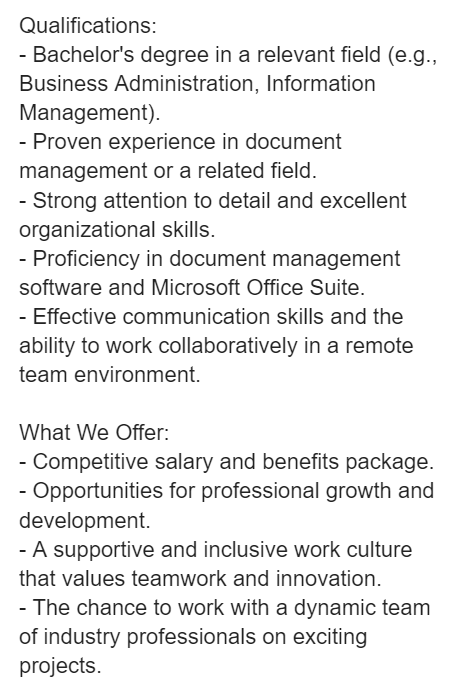
Screenshot of spam email listing the qualifications and more information about the company.
Most of the job description in the body of the email seems fine at first glance, but after searching for the text in Google inside quotation marks “like this!” showed us it also appeared on other job boards under different companies.
Scammers can easily copy real job descriptions to make their scams more convincing, so always do a search of the exact wording in quotation marks to check.
4. Check for Generic Greetings
The salutation was to an “Esteemed Candidate,” although my client’s name was clearly available through LinkedIn and even her email address, and a real recruiter would know exactly who they were reaching out to.
Scammers often use generic greetings like "Dear Applicant" instead of addressing you by name.
A legitimate recruiter almost always personalizes the greeting.

Screenshot of the greeting, which says “Dear Esteemed Candidate”
5. Check the Email Domain and Signature
Always verify that the email is from a legitimate domain, not from a free email service like Gmail, Yahoo, or another suspicious-looking domain.
Be cautious of slight misspellings or extra characters in what appears to be a legitimate domain.
By searching “Sorensen Gross company email address domain” or by going to the company website’s contact page, we were able to determine this was not the real domain the company used. This spam email domain was @recruitmentsorenengross.com which didn’t match the rest of the company’s listed emails.
Legitimate recruiters will only contact you from their official company email address.
6. Be cautious if the email signature is missing professional contact details
The signature does have include full name and team, but does not have additional contact information or a specific team position listed, which is suspicious.
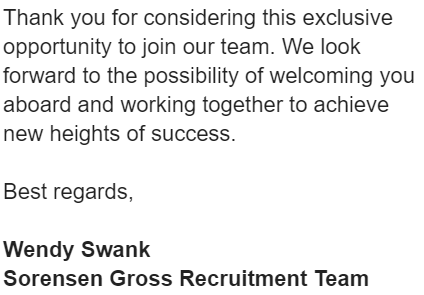
Signature block of the spam message which only lists "Wendy Swank, Sorensen Gross Recruitment Team" and no other contact information.
7. Research the Recruiter and Company
Search for the recruiter’s name on LinkedIn or the company's official website to ensure they are legitimate.
Verify that the company exists and check its contact information against what is provided in the email.
When we searched “Wendy Swank” on the company website and LinkedIn, we did find another person whose last name was Swank, but their first name did not match. “Wendy” didn’t exist!
Still not sure?
8. Contact the Company Directly to Verify!
Find official contact information directly from the company website. Avoid using any contact information provided in the suspicious email. Never respond to a suspicious message.
Call or email the company’s HR department to verify the legitimacy of the recruiter and the job offer.
Explain that you received an email and provide any details or documentation they request for verification.
9. Avoid Clicking Suspicious Links or Attachments
Do not click on links or download attachments from unsolicited emails without verifying their authenticity. Never respond and let the scammer know they have reached a live person.
These could be phishing attempts to steal your personal information or infect your computer with malware.
10. Avoid Sharing Your Personal Information
Legitimate recruiters do not ask for sensitive personal information like Social Security numbers, banking details, or passwords early in the recruitment process.
Bonus Tip: Report Suspicious Emails
Report suspicious emails to your email provider by marking it as spam. You can also contact the company being impersonated, report it on the job board site you found it on (if applicable) and create a quick Federal Trade Commission report by clicking here.
This can help prevent others from falling victim to the scam.
We sent an email directly to the company HR department notifying them that they were being impersonated, and they were able to issue a warning to help future applicants.
